International Art Authentication is a private forensic laboratory dedicated to the scientific verification and material analysis of fine art.
Operating at the intersection of art history and advanced material science, we provide discreet, evidence-based authentication services to collectors, institutions, legal professionals, and insurers worldwide. Our conclusions are derived from rigorous laboratory examination, AI-assisted analytical modeling, comprehensive provenance investigation, and senior-level connoisseurship.
Each work undergoes a structured, multi-tiered review process designed to eliminate speculation and minimize subjectivity. From microscopic pigment stratigraphy and spectroscopic material testing to radiographic imaging and technical comparative study, every determination is grounded in measurable data and documented methodology.
In a market where uncertainty carries significant consequence, we provide clarity with precision. Our mandate is singular: to establish, with scientific integrity and professional independence, whether a work is authentic, misattributed, altered, or inconsistent with its claimed origin.
Certificate Inquiry
One-Click Certificate Information Inquiry
Our authentication reports are designed to resonate with experts—and to drive favorable outcomes.
Science the art market trusts.












Microscopic Pigment and Canvas Fiber Analysis
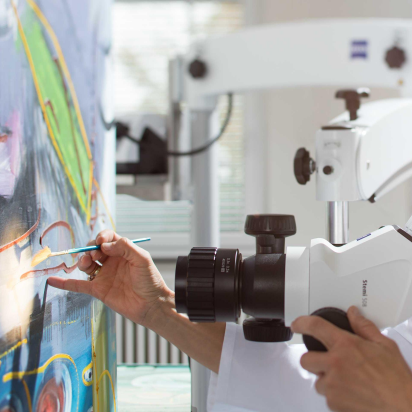
Microscopic examination constitutes the foundation of technical authentication. Through the use of stereomicroscopy and high-magnification metallurgical imaging, specialists are able to assess pigment particle morphology, stratigraphic layering, and the structural characteristics of the canvas support.
Cross-sectional sampling reveals the sequential build-up of ground layers, paint applications, glazes, and varnish coatings, offering critical insight into both artistic method and subsequent interventions. Variations in pigment crystallinity and granularity frequently indicate distinctions between historically documented materials and later synthetic compounds.
Equally, analysis of canvas weave density, fiber composition, and aging patterns may provide valuable comparative data consistent with regional and chronological production methods. Microscopic study thus serves not merely as a material investigation, but as a primary evidentiary tool in establishing authenticity and artistic process.
Ultraviolet Fluorescence Examination
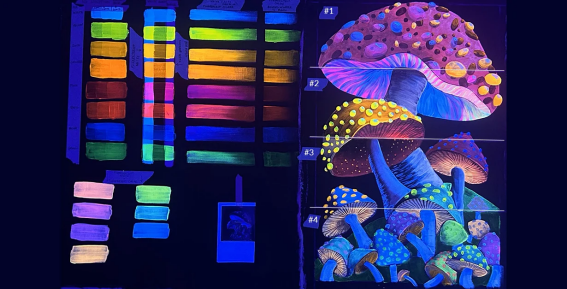
Ultraviolet illumination provides a non-invasive means of evaluating surface condition and restoration history. When exposed to controlled UV wavelengths, natural resin varnishes typically emit a characteristic fluorescence, while areas of later retouching or synthetic overpaint often appear as dark or irregular passages.
This method allows conservators to identify restorations that may not be discernible under normal light, including localized inpainting, varnish inconsistencies, and structural repairs. The technique is indispensable in the preparation of condition reports and in assessing the degree to which a work has been altered or conserved over time.
UV examination, while diagnostic rather than definitive in isolation, forms an integral component of the broader technical evaluation process.
Infrared Reflectography

Infrared reflectography permits the visualization of underdrawings and compositional revisions concealed beneath the visible paint surface. Many artists refined their compositions during execution, leaving evidence of adjustments—pentimenti—that are no longer apparent to the naked eye.
The presence, character, and spontaneity of such underdrawings may provide meaningful insight into authorship. Works produced as later copies frequently lack the structural evolution observable in original compositions, often exhibiting mechanical or transferred outlines rather than exploratory sketchwork.
As such, infrared analysis offers a rare window into the artist’s creative process and serves as an important comparative instrument in authenticity assessments.
Radiographic (X-Ray) Examination
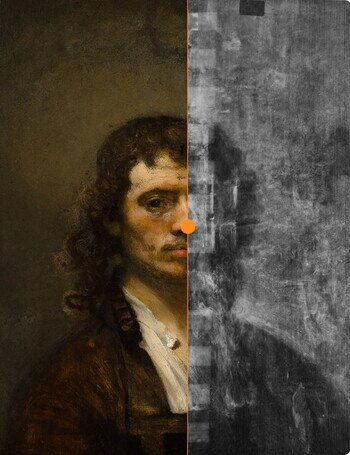
Radiographic imaging reveals the internal architecture of a painting by exploiting differences in elemental density among pigments and structural components. Lead-based pigments, for example, absorb X-rays more readily and appear prominently within the resulting image, while organic materials remain comparatively translucent.
This technique may disclose concealed compositions, alterations in structure, canvas joins, nail patterns, and earlier abandoned works beneath the visible surface. In certain instances, the discovery of an underlying composition consistent with a known artistic practice can significantly reinforce attribution.
Radiography remains a cornerstone of museum-level technical examination and provides critical structural evidence within the broader authentication framework.
Spectroscopic Pigment Analysis (XRF, Raman, FTIR)
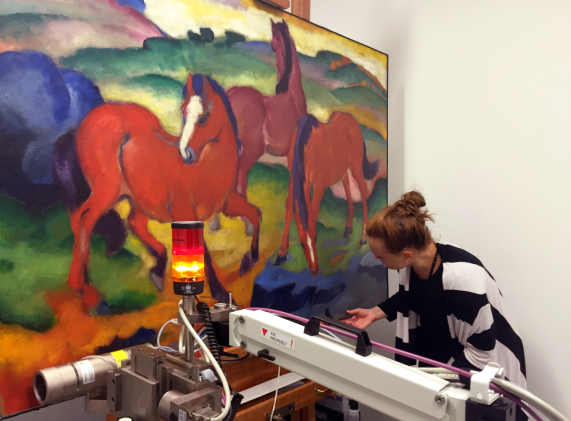
Advanced spectroscopic techniques enable the precise identification of elemental and molecular composition within paint layers. X-ray fluorescence (XRF) analysis determines the presence of specific metallic elements, while Raman spectroscopy and Fourier-transform infrared spectroscopy (FTIR) identify crystalline and organic compounds.
Such analyses are particularly significant in verifying chronological plausibility. The detection of pigments introduced in the twentieth century within a work purportedly dating from an earlier period may raise substantive concerns regarding authenticity.
Material analysis of this nature represents one of the most objective scientific measures available in the authentication of works of art, bridging art historical scholarship with empirical laboratory investigation.